
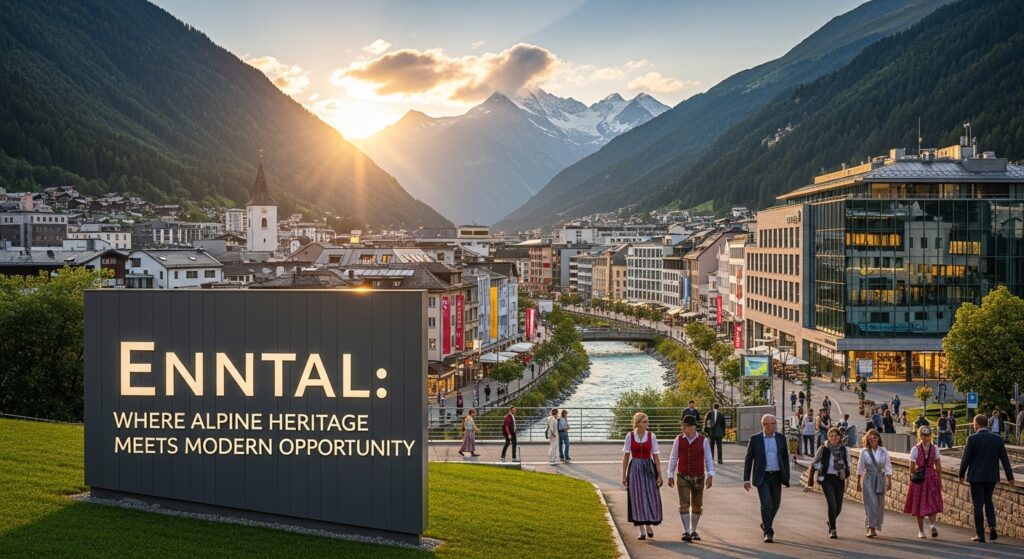
The first time you enter Enntal, the road narrows gently, the mountains draw closer, and the air seems to change texture. It feels quieter, but not empty. Instead, there is a sense of purpose embedded in the landscape—a valley that has learned how to endure, adapt, and quietly innovate over centuries. This is not just a scenic Alpine corridor. Enntal is a living example of how geography, culture, and modern ambition can intersect to create sustainable opportunity.
Stretching along the River Enns in central Austria, Enntal has long been shaped by movement—of water, of trade, of people. Today, that same movement is redefining how regions outside major cities can still play a decisive role in entrepreneurship, technology adoption, and future-focused economic thinking.
Understanding Enntal Beyond the Map
At first glance, Enntal is easy to define geographically. It is an Alpine valley framed by dramatic peaks and fertile lowlands, connecting communities that have relied on the Enns River for centuries. But geography alone does not explain its resilience. Historically, the valley functioned as a trade passage linking northern and southern Europe, making it an early hub of exchange rather than isolation.
That history matters today. Regions that learned early how to trade, negotiate, and adapt tend to retain those skills culturally. In Enntal, this shows up in small but globally connected manufacturing firms, export-oriented family businesses, and a growing openness to digital tools that allow local enterprises to reach international markets without leaving the valley.
A Landscape That Shapes Mindset
Entrepreneurs often talk about mindset, but rarely about how physical surroundings influence it. In Enntal, nature imposes constraints that quietly teach efficiency. Space is valuable, seasons are non-negotiable, and long-term thinking is essential. You build not just for growth, but for durability.
This has created a culture where businesses are less driven by short-term hype and more by sustainable value. Whether it is precision engineering, renewable energy initiatives, or high-quality agricultural production, Enntal enterprises tend to optimize before they expand. For founders and operators, this approach feels increasingly relevant in a global economy that is moving away from excess and toward resilience.
Economic Evolution in Enntal
Enntal’s economy has shifted significantly over the past few decades. Traditional sectors like timber, agriculture, and metalworking have not disappeared; instead, they have modernized. Advanced machinery, data-driven production planning, and environmentally conscious processes are now standard rather than exceptional.
At the same time, the valley has attracted knowledge-based work. Remote professionals, small software consultancies, and digital service providers are increasingly choosing Enntal as a base. Reliable infrastructure, quality of life, and proximity to larger Austrian cities make it possible to operate globally while living locally.
This hybrid economy—where physical production and digital services coexist—gives Enntal an unusual kind of stability.
Infrastructure as a Silent Advantage
One of Enntal’s most underestimated strengths is its infrastructure. Transport routes follow historical paths but meet modern standards, connecting the valley efficiently to regional and international markets. Energy infrastructure, particularly hydroelectric power from the Enns River, reinforces the region’s reputation for sustainability.
Digital infrastructure has also improved steadily. High-speed connectivity, once considered a rural luxury, is now a strategic priority. For tech readers and founders, this matters more than scenery. It means teams can collaborate globally, data-heavy processes can run smoothly, and location becomes a choice rather than a limitation.
Enntal and the New Definition of Growth
Growth in Enntal looks different from growth in urban startup hubs. It is slower, but often more controlled. Businesses here tend to scale through specialization rather than aggressive expansion. They become very good at one thing, then export that expertise outward.
This approach aligns with modern entrepreneurial thinking that values profitability, operational clarity, and long-term relevance over rapid valuation spikes. For founders burned out by high-pressure ecosystems, Enntal represents an alternative model—one where ambition does not require constant acceleration.
Innovation Rooted in Tradition
Innovation in Enntal rarely appears flashy. Instead, it emerges through refinement. Traditional crafts incorporate modern materials. Agricultural operations integrate sensors and automation. Manufacturing firms adopt predictive maintenance and smart logistics.
What makes this innovation credible is its grounding in real-world constraints. Solutions are tested against weather, terrain, and resource limits. As a result, technologies developed or refined in Enntal often translate well to other regions facing similar challenges, making them commercially valuable beyond local borders.
Quality of Life as an Economic Factor
In discussions about entrepreneurship, quality of life is often treated as secondary. In Enntal, it is central. Short commutes, access to nature, strong community networks, and lower stress levels directly influence productivity and decision-making.
Founders who relocate to the valley often report clearer thinking and more consistent output. Teams benefit from stability, and employee retention improves when work is integrated into a balanced lifestyle rather than competing with it. In this sense, Enntal turns what many consider a lifestyle perk into a measurable business advantage.
How Enntal Compares to Urban Innovation Centers
To understand Enntal’s position more clearly, it helps to compare it with typical urban innovation hubs.
| Aspect | Enntal | Major Urban Hubs |
|---|---|---|
| Growth Style | Sustainable and specialization-driven | Rapid and scale-at-all-costs |
| Cost Structure | Lower operational and living costs | High rents and overhead |
| Talent Retention | Strong due to lifestyle stability | Challenging due to burnout |
| Innovation Focus | Practical, applied solutions | Experimental and trend-driven |
| Long-Term Resilience | High | Variable |
This comparison does not suggest that one model is superior in all cases. Instead, it shows why Enntal is increasingly attractive to entrepreneurs who value longevity over volatility.
The Strategic Appeal for Entrepreneurs and Founders
For entrepreneurs evaluating where to build or relocate, Enntal offers a rare combination: access without congestion, ambition without excess, and innovation without detachment from reality. The valley does not try to compete with global capitals on scale. It competes on coherence.
This coherence makes it easier to align personal values with professional goals. Businesses that emphasize sustainability, craftsmanship, and long-term trust find a natural home here. In a world where reputation travels fast and mistakes linger, such alignment is not a soft benefit—it is a strategic one.
Enntal’s Role in a Decentralized Future
As work becomes more decentralized, regions like Enntal gain relevance. The assumption that innovation must cluster in megacities is increasingly outdated. Talent can operate from anywhere, but not everywhere offers the same balance of infrastructure, stability, and inspiration.
Enntal stands out because it does not attempt to reinvent itself artificially. It evolves by extending what already works. This makes its development more credible and less fragile than trend-driven transformations seen elsewhere.
Looking Ahead: Why Enntal Matters Now
The global economy is entering a phase where efficiency, sustainability, and human-scale systems matter more than speed alone. In this context, Enntal is not a nostalgic retreat—it is a preview. It shows how regions can remain economically relevant without sacrificing identity.
For tech readers, it offers a case study in applied innovation. For founders, it suggests a different rhythm of success. And for entrepreneurs questioning where the next decade of meaningful work might unfold, Enntal quietly offers an answer.
Conclusion
Enntal does not announce itself loudly. It does not chase trends or promise instant transformation. Instead, it demonstrates something more valuable: how continuity and progress can coexist. In an era defined by disruption, that balance may be the most disruptive idea of all.
The future will not belong only to the biggest cities or the fastest movers. It will also belong to places like Enntal—regions that understand their past well enough to build a future that lasts.